How to Know When You’ve Outgrown the Kitchen Table Phase of Production

If you’ve ever capped bottles by hand in your garage… this one’s for you.
There’s a stage in every growing product brand where scrappy works. You count capsules at a folding table. You tighten caps manually. You wrap pallets by hand before the truck arrives.
It’s exciting. It’s proof the business works.
But then something changes.
You miss a deadline because production took longer than expected.
A retailer notices inconsistent packaging.
You hire someone whose primary job is sticking on caps or counting tablets.
That’s not failure.
That’s growth outpacing your tools.
And the brands that scale aren’t the ones working harder — they’re the ones reinforcing their workflow at the right moment.
3 Early Warning Signs You’ve Outgrown Manual Packaging
Growth doesn’t break systems overnight. It stretches them gradually.
1. Are You Spending More Time on Capping Than You Used To?
When bottles move smoothly through filling but slow down at capping, your line is compensating for inconsistency. Manual torque adjustments, re-tightening, and supervision increase as volume rises.
If someone is hovering to “double-check caps,” your process is carrying more load than it was designed for.
2. Is Counting and Bottling Tablets Becoming a Bottleneck?
Manual capsule or tablet counting works at low volume. But as daily production increases, recounts and verification checks begin to consume more time than the actual filling process.
According to the 2025 Labor Trends outlined by Tutor, automation at high-repetition steps reduces long-term labor strain and improves margin protection.
When precision depends on supervision instead of system design, scaling becomes difficult.
3. Pallet Wrapping Feels Like the Final Exhausting Step
After production is complete, someone still has to wrap pallets — manually.
Inconsistent tension. Extra stretch film. Slower shipping turnaround.
Lean operational principles show that bottlenecks at end-of-line processes compound inefficiencies across the entire workflow.
Shipping stability protects everything upstream.
How the Right Production Equipment Supports Scalable Workflow
Scaling doesn’t require rebuilding your entire operation. Often, it means reinforcing the steps carrying the most pressure. Stabilizing capping, counting, and pallet wrapping transforms reactive production into predictable output.
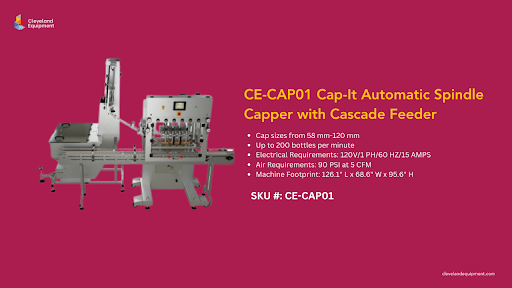
1. CE-CAP01 Cap-It Automatic Spindle Capper with Cascade Feeder
Hand-capping may feel manageable — until it becomes the choke point. The CE-CAP01 introduces automated cap feeding and controlled torque, ensuring consistent cap application at higher speeds.
CE-CAP01 Cap-It Automatic Spindle Capper with Cascade Feeder
What improves immediately:
- Uniform cap tightness
- Reduced rechecks
- Increased throughput
- Lower operator fatigue
Instead of hoping each bottle is sealed correctly, the system guarantees repeatability.
2. CENTC100 Capsule Pill & Tablet Counter Bottling Machine
As supplement brands scale, counting accuracy becomes mission-critical. The CENTC100 automates tablet and capsule counting with precision, integrating directly into your bottling workflow.
CENTC100 Capsule Pill & Tablet Counter Bottling Machine
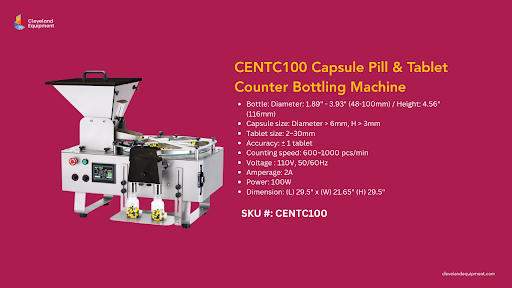
Operational advantages include:
- Faster bottle processing
- Reduced recounts
- Higher counting accuracy
- Improved production planning
When counting stabilizes, forecasting becomes easier and production feels controlled instead of reactive.
3. CE-615 Pallet Stretch Wrapper
A pallet wrapper is designed to securely wrap products on a pallet with stretch film, ensuring stability during storage and transport. It applies consistent tension automatically, reducing waste and improving load security.

Benefits include:
- Reduced product damage
- Lower stretch film usage
- Faster pallet preparation
- Improved logistics efficiency
End-of-line consistency protects margin and customer satisfaction.
What Businesses Are Saying
Frank H. — December 23, 2024
“I very much appreciated the salesman (Betsy Barker) walking me through the various machines and offering advice. I would have never had quite so pleasant of an experience had I merely ordered online without consulting her.”
Brandon R. — December 19, 2024
“We have been so happy with our new filling line. It has already paid for itself! It has literally cut our production time in half! (CFL 200)”
Efficiency improvements are measurable — not theoretical.
Frequently Asked Question: Are We Too Small for Automated Equipment?
This hesitation is common.
You don’t need to be a massive manufacturer. You need to match your tools to your volume.
If you are:
- Hiring staff for repetitive manual steps
- Missing occasional deadlines due to slow throughput
- Supervising high-frequency tasks constantly
Then your workflow has matured beyond your original setup.
Upgrading doesn’t mean abandoning hustle. It means protecting it.
How to Evaluate Your Workflow This Quarter — And Reinforce What Matters
Before making any changes, step back and evaluate strategically:
- Identify your slowest repeatable step.
Where does production consistently slow down? - Calculate how much labor time is tied to it weekly.
Multiply small delays by total output. The numbers add up fast. - Estimate how often rework occurs.
Recounting. Re-capping. Rewrapping. How frequent are corrections?
Where repetition, labor strain, and rework intersect — that’s where reinforcement belongs.
Growth doesn’t collapse operations. It stretches them.
The businesses that scale successfully aren’t the ones pushing harder. They’re the ones strengthening their workflow before strain becomes disruption.
You don’t need to automate everything.
You just need to stop doing high-volume work with low-volume tools.
→ Explore production solutions: https://clevelandequipment.com
→ Speak with a specialist to review your workflow
→ Schedule a production assessment call
Final Thoughts: You’re Not a Garage Operation Anymore
There’s pride in remembering where you started.
But staying in the kitchen-table phase too long turns hustle into bottleneck.
When your production tools match your production volume, deadlines feel manageable. Output stabilizes. Supervision decreases. Growth becomes predictable.
That’s not overreacting.
That’s evolving.